
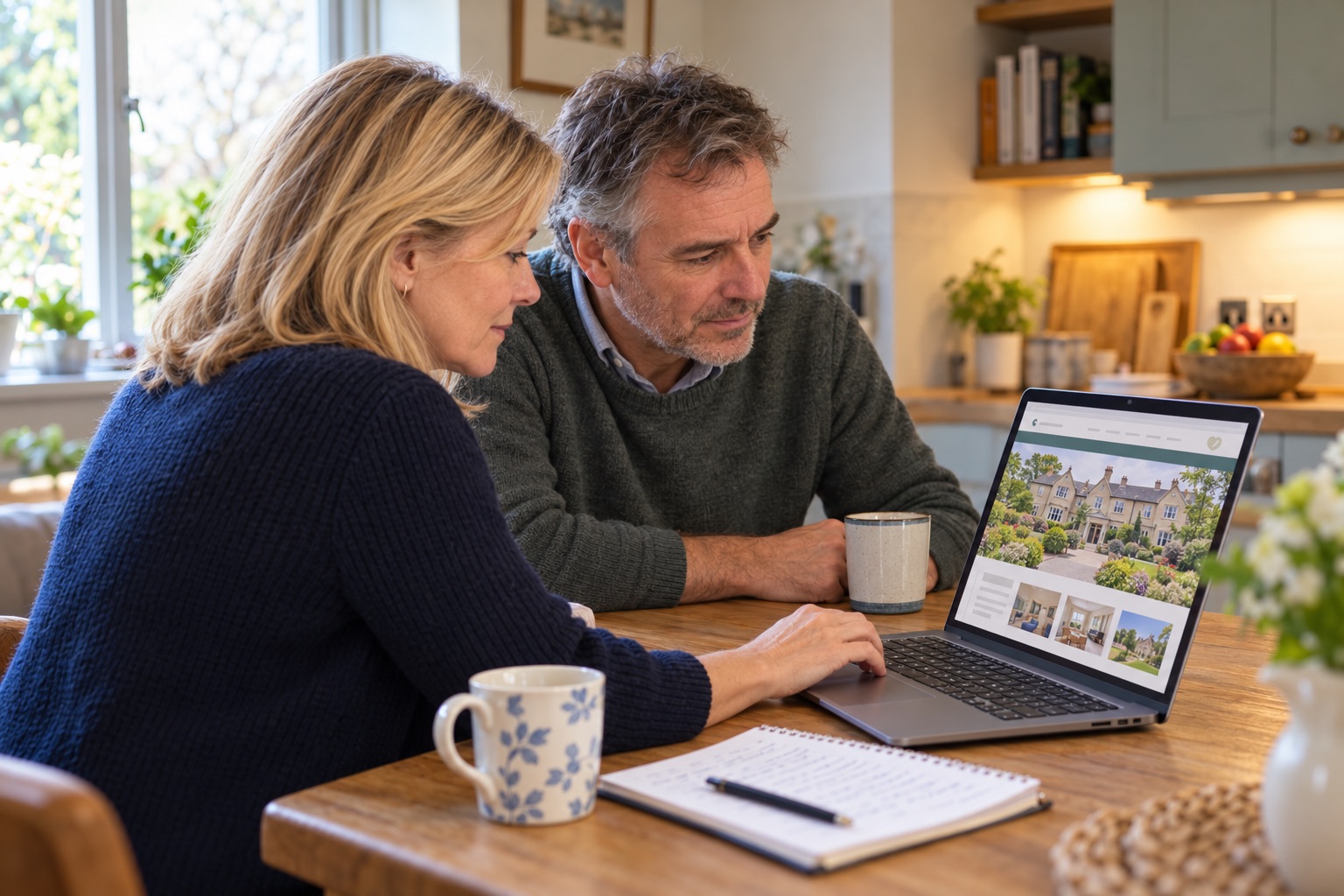
Picture the person who will eventually ring you. She is fifty-eight. Her mum had a fall last month and the hospital has said, kindly but firmly, that going home alone is no longer an option. She has a week, maybe two. She has never chosen a care home before and she is doing it after work, on her phone, with the television on.
She will look at your home four times before she picks up the phone. Each time, she is asking one question: can I trust these people with my mum? Most homes answer that question badly at every stop, without ever knowing a family was there.
The search
It starts with Google. She types something like "care homes near Wetherby" or "dementia care Harrogate". She does not type your name, because she does not know it yet. What she sees is a map with a handful of pins, star ratings underneath, and a list of websites.
Three things decide whether you are in that first handful. Whether your Google Business Profile is claimed and complete. Whether it has recent reviews. Whether the care type she typed appears anywhere on your website in plain words. A home that offers dementia care but never uses the phrase on its own site is invisible to this search.
If you are not in that first view, she has not rejected you. She has simply never seen you. That is worse.
The reviews
Next she reads what other families have said. Google reviews first, because they are right there, then carehome.co.uk if she knows it exists. She is reading for two things: whether the recent reviews are good, and whether anybody from the home replies.
A home with eleven reviews, the newest from 2023, tells her nobody is paying attention. A home with a scathing review and no response tells her the management does not care what families think. A home with a mix of reviews and a calm, personal reply under each one tells her these are people who listen. That last home is now on the shortlist, even with the scathing review.
The reply matters more than the rating. A measured response to a poor review does more for trust than another five-star one.
Your website, on a phone, at night
Now she opens your website. On a phone. She is not reading it the way you read it when you signed it off on a desktop in the office.
She wants, in roughly this order: what kind of care you provide, what it costs, what the rooms look like, who runs the place, and how to visit. If any of those takes more than two taps to find, she gives up and opens the next tab.
Fees are the one most homes hide. The reasoning is usually "it depends on the assessment", which is true and unhelpful. A family that cannot find a figure assumes one of two things: it is more than they can afford, or you are the kind of place that springs it on them later. Either way they stop. A "from" figure with a sentence of explanation keeps them reading.
Photography does the rest of the work. Stock images of smiling pensioners who are not your residents, in a lounge that is not your lounge, are recognised instantly. A real room with a real window and a slightly worn armchair is reassuring in a way a brochure shot never is.
The directory listing
The fourth stop is a directory, most often carehome.co.uk or Autumna. For some families it is the first stop, but for most it comes after the website, as a way of checking you against the others.
Here she is comparing like with like: the same fields for every home. Which means gaps show. No fees listed. Four photos where the home next door has thirty. A manager's name that does not match the one on your website. Each of these is small. Together they read as a home that has not been looked after.
The listing is also where she sees your review score sitting next to your competitors', with no context. If yours is lower, the website will not rescue it.
The fixes that cost nothing
None of what follows needs a budget. It needs someone to own it for an afternoon and then for an hour a month.
- Claim and complete the Google Business Profile. Correct hours, the right category, a current photo, the manager's name.
- Reply to every review from the last twelve months, good and bad, in the manager's own words.
- Put a "from" fee on the website, with one honest sentence about what changes it.
- Open your own site on your own phone and try to book a visit. Count the taps.
- Bring the directory listing up to the standard of the website: same photos, same fees, same manager.
Then ask someone who has never been to the home to do the search, honestly, and tell you where they got stuck. That is the cheapest mystery shop you will ever run. If you would like us to do it properly, with the calls and the visit as well, that is the first thing we offer every new client, and you can read about it under research and strategy.
Want this looked at for your home?
Thirty minutes on your homes, your occupancy mix and what you've already tried. No pitch deck.